English
Every day we offer FREE licensed software you’d have to buy otherwise.
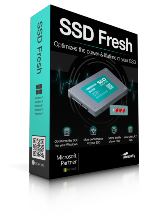
SSD Fresh 2022 was available as a giveaway on December 25, 2022!
Today Giveaway of the Day

Reliable data protection and disaster recovery solution.


SSD drives are the Holy Grail of computer tuning. The hard drives have dramatically improved access times compared to traditional plates. SSD Fresh brings out even more speed from SSD drives and ensures that they last longer. The new version offers a new program interface and a new "deactivate sleep mode" function, which ensures significantly fewer write accesses and thus further increases the lifetime of the SSD.
- Adjust the system to the SSD;
- Avoid write access;
- Increase performance.
System Requirements:
Windows 7/ 8/ 8.1/ 10/ 11
Publisher:
AbelssoftHomepage:
https://www.abelssoft.de/en/windows/system-utilities/ssd-freshFile Size:
4.5 MB
Licence details:
Lifetime
Price:
$10.00
How would you improve SSD Fresh 2022?
No similar feedback found. Feel free to add yours!
GIVEAWAY download basket

Developed by Informer Technologies, Inc.

Developed by AOMEI Tech Co., Ltd.

Developed by Belarc, Inc.

Developed by Disc Soft Ltd.
Comments on SSD Fresh 2022
Thank you for voting!
Please add a comment explaining the reason behind your vote.
Please add a comment explaining the reason behind your vote.
iPhone app giveaways »

$0.99 ➞ free today

Carats brings a gemstone weight calculator, unit converters, sales records, and charts to your iPhone and iPad.
$0.99 ➞ free today

GCSE Statistics is a separate GCSE from GCSE Maths, with its own content and its own exam papers.
$0.99 ➞ free today

Prayer Times gives you what you need to pray on time without ads, feeds, accounts or distractions.
$0.99 ➞ free today

Baby Art is the perfect way to get your little one interested in the wonders of art.
$0.99 ➞ free today
Android app giveaways »

Come to the cooking adventure, as a passionate chef, you are invited to take part in those challenges.
$0.99 ➞ free today

$4.99 ➞ free today

Welcome to Sports Master, the ultimate trivia game designed for sports enthusiasts!
$2.49 ➞ free today

Merge Cafe is a brand new merge game where you can combine tasty treats to make them even sweeter.
$4.99 ➞ free today

Become a leader and idle defender your warriors from the invading monsters.
$0.99 ➞ free today
After reading comments, SSD's aint as good as cooked up to be.. I've got a nearly 30 years old Windows 95 which still boots up perfectly. Maybe slow, but it still gets the job done.
Save | Cancel
Can I use this program without turning of System Restore? This should be a simple Yes, there is a switch for that, or no, you have to turn it off--- thx
Save | Cancel
From all the above comments, I did not understand whether the pro are better than the con. I expect to hear some clear definition. Thank you.
Save | Cancel
thank you for all.
Merry Christmas
Save | Cancel
Thank you & Merry Christmas & A Happy New Year...
Save | Cancel
I raised my eyebrows when I read this today. So I went looking for reviews of this software. Real reviews, unlike many which are little more than ads for the program.
I found this website: https://malwaretips.com/threads/ssd-fresh-anyone-heard-of-this.105696.
"I spent many years working on SSD firmware and this seems like it's misguided at best. Windows 10 already understands the differences between a SSD and HDD and that automatically turns off most forms of defragmentation. Windows also redefines Disk Optimization's weekly pass to do TRIM instead of defragmentation.
For the other things they say are "unnecessary" don't make sense:
SSDs do still need indexing. It's still much faster to find files and content in files with an indexing database than without, no matter how fast your SSD is.
Hibernation has nothing to do with SSDs. It's for both when your laptop runs out of power during sleep, as well as for reducing the amount of standby power draw. Whether or not you want hibernation has little to do with whether or not you have an SSD.
Disabling/enabling sleep mode on SSDs is basically useless. On a SATA SSD, when you tell it to sleep, it either does nothing or it is used by the SSD firmware as a hint that it can more aggressively do background cleanup tasks without affecting performance. This was important for first generation SSDs but these days it's totally useless and it doesn't make a difference.
Windows 10 already disables prefetch and SuperFetch if your Windows drive is a SSD.
A lot of these options shouldn't be randomly touched. This isn't Windows 98 which requires a bunch of mystery tuning options to behave well.
The only thing remotely useful is SMART checking, which can be done using a variety of free apps that don't try to upsell you to a $10 premium version....
Save | Cancel
the Biggest best thing you can do to extend the life of an SSD is to not provision 10GB of space for every 500GB. Example when activating a 500GB drive remove 10GB from total size, for 1TB don't activate 20GB. This will leave plenty of replacement blocks to replace worn out cells. This will protect your SSD from total failure and you will always have time to replace the drive with out loosing data. Merry Christmas!
Save | Cancel
mike, It's just maths, each flash block can only be erased a few thousand times before it's had its life, whenever anything is over-written it actually gets moved to a new block and the old block erased a little while later. The fuller the drive is the more often blocks will be reused (as there will be less spares). It really depends on how long you want the drive to last and how full it is. If you upgrade your SSD regularly then you're probably fine.
Save | Cancel
The cheaper SSD´s are programmed to work for 2 years. This is how the world works. Everything we buy works on "programmed obsolesce". It´s up to us to change this, but after many years fighting for our consumer rights without no interest I can´t do more. It´s up to you now if you want more lifetime on your stuff.
Save | Cancel
Hans Oellers,
Tell me about it. I had a refrigerator and washer that lasted over thirty years. Have to say, once you buy something, it becomes obsolete, especially cars.
Save | Cancel
You can never extend the life of your SSD, never. An almost 3 year old Phison 128GB; Model PS5012-12C was at 70% good on the last days, now it no longer works, the result; no signal! That Phison 128GB SSD is a middle finger large, with 5 ICs on the small print.
Save | Cancel
Steve Alcorn, the maker explains his claim as follows:
The storage cells of SSD hard disks are like this: they have a limited number of possible read and write operations. To increase the lifetime of the disks, the number of accesses should be reduced. SSD Fresh switches off all superfluous Windows functions that cause unnecessary access to the memory cells. These include Windows defragmentation, file indexing, timestamp creation, prefetch function, boot file defragmentation, Windows logging, system restore and saving short names for folders and files (DOS compatibility). The software also displays general drive information and reads the S.M.A.R.T. (Self-Monitoring, Analysis and Reporting Technology) data of the disks. Conclusion: With SSD Fresh, the expensive SSD can be optimized with just a few clicks, made faster, write operations reduced and thus used for a long time.
Save | Cancel
Steve Alcorn,
Wrong I'm afraid. That's a myth which comes from bad explanations and misunderstandings on how a SSD work. You sure can extend the advertised average life span life of a SSD!
A SSD deteriorates mainly because of write operations. Eliminate unnecessary write operations (mainly coming from your OS) and you extend the advertised average life span. This is not rocket science, but is quite often explained badly/ without nuance.
A bad configured OS can shorten the lifespan of a SSD enormously (eg: search indexing in Windows). As such, tools which help you to turn off or turn on certain features in your OS can extend the lifespan of the SSD for sure (or vice versa for that matter).
Of course, a bad SSD is still bad. You can't revive a deteriorated or bad SSD. But, again, if you eliminate write operations as much as possible, you sure can extend the time it takes before the SSD unavoidably deteriorates.
The program offered here does NOT false advertise. It does explain the above and doesn't make any promises. And it does offer the ability to easily configure some key OS features, which are otherwise buried (to deep) into the OS for the average user, which can highly influence the SSD lifespan.
Is this program necessary? Absolutely not. You can do everything it does within the OS itself. So, it is more of a convenience tool + some basic explanation tool for the basic/average user.
Save | Cancel
Steve Alcorn, I'm going to check it out. Their posted reasoning may be true. No one can know everything about any subject. I've never met or heard of anyone who really does. We keep making progress though, in all areas. You might want to consider that.
Save | Cancel